Wednesday, March 29, 2006

Singin' In the Rain

(with apologies to my colleagues)

The following are instruments that you cannot play in a raging downpour:

Violins,Violas, Cellos, Basses, Harps, Piccolos, Flutes, Saxophones, Oboes, Clarinets, Bassoons, Contrabassoons, Timpani, Bass Drums, Traps, Marimba, Xylophones, Pianos

Which leaves (ignoring issues with rust, and valves, and other moving parts):

Trumpets, French Horns, Trombones, Tubas, Cymbals, Triangles, The Gong, Bells and
More Cowbells

The weather outside is frightful, and the fire ain’t so delightful. Fact is, it’s a bizarre series of weather swings we’ve been having here in Houston the last few weeks. Most orchestral instruments, and string instruments in particular, are horribly sensitive to extreme weather variations. This is due to the fact that they are made mostly out of WOOD, which expands and contracts. Think of a door in your house that sticks frequently. String players are always having to go and get their instruments adjusted, clamped and reglued. Many have some sort of dehumidifier in their house. I won’t let anyone enter my studio from the garden when my viola is out. I can almost hear it cracking . Most players have what is called a “picnic” instrument, for those outdoor performances. Bows are almost as bad, just less moving parts. Lately huge improvements in carbon fiber and graphite technology have enabled us to use carbon fiber bows that work almost as well as our wooden ones. Plus they come in nifty colors and you can swordfight with them backstage. There are companies that make entire stringed instruments of carbon fiber, but it is only the bows that have reached the status above being an odd thing.

Historically, this is not anything new. Though the basic forms of the acoustic string family as we know them now have not changed since the 1600’s, throughout the centuries and all in the name of science, string instruments have been attempted in a variety of materials. Metals, pottery, and plastic have occasionally replaced the standard maple, spruce, ebony, and willow. In the USA in the 1930’s, double basses made of aluminum were developed for military orchestras and similar occasions. Unfortunately, the experiments generally sound like crap.

Maybe one day advancements will be such that the following situation would not have the potential for unmitigated disaster. When the Philadelphia Orchestra was rehearsing Stravinsky’s Rite of Spring in their new Kimmel Center, the fire-suppression system was activated, soaking the stage, the balconies and the seats. Fleeing musicians were drenched as they used their bodies and their clothing to try to shield their instruments from the downpour, and a $75,000 Steinway piano was destroyed. Former Houston Symphony Maestro Christoph Eschenbach at the time was the new Maestro-elect of Philly and had a very Eschenbach-ian response to the situation.

"It was like a natural phenomenon," Eschenbach told the Philadelphia Inquirer. "It was The Rite of the Sprinkler."


Site Meter

Wednesday, March 22, 2006

Violists, Pirates, and Hairdos

Violists are generally the most laid-back section of the orchestra. They are often, but not always, ex-violinists that have seen the error of their ways and switched to a more friendly, mellow, sensible instrument. There’s a reason there are more websites for viola jokes than any other instrument- it’s the violists that maintain and run them! We’re like violinists with a better sense of humor. The world may think of the typical bass player as mellow, but in reality when those guys get together, it won’t be long before the conversation turns to the bass. Violists will never talk shop, not even when they are at the shop.

A typical Houston Symphony viola section conversation could include “The Sopranos” plot synopses, conspiracy theories on our section’s latest illness (see last week's blog), bets on when rehearsal will end, votes on who has the greatest hairdo that day (this week’s conductor, Claus Peter Flor, wins hands down. It’s Beethoven hair-fantastic and expressive), bets on how many times a conductor may repeat a certain word or phrase during a rehearsal, discussions on shoes, bike shoes, dogs, brownie recipes, and so on. Sometimes these conversations take place at the “viola table” at the breaks in rehearsal or concerts, sometimes silently on stage with secret signals during rehearsals, sometimes in pirate speak (yarrgh, avast ye swabbies!!). For Halloween, the section has been prisoners, witches, and most successfully and fittingly, pirates (arrgh! Buccaneer scalawag!!). We have been recently featured in a Journal of the American Viola Society (a collection of non-shop-talking people) article, "Meet the Pirates of the Houston Symphony."

Although my research on other famous pirates who were also violists is quite sketchy, there are many(in)famous violists in history: J.S. Bach, Beethoven, John Cale, (ex-Velvet Underground member), Jimi Hendrix, Linus Pauling (1986 Nobel prize for Chemistry), John Montgomery (Ford Foundation Professor of International Relations, was the Allied officer in charge of the reconstruction of Hiroshima), Mozart, Naruhito (Crown Prince of Japan), and Edward Teller, one of the fathers of the nuclear bomb.

One can usually tell if a composer was also a violist by the quality of the viola parts in the music. Two of this week’s composers, Felix Mendelssohn (1809-1847) and Antonin Dvorak (1841 –1904) played the viola often in their lives. Dvorak started out professionally playing viola in an orchestra conducted by Smetana. As his fame grew as a composer, he received an invitation to come to America to start a music conservatory. He lived for a while in New York and then Spillville, Iowa, where he bred pigeons and loved to sit by the train tracks. He had a thing for locomotive engines. See? NOT TALKING SHOP, paramount in the violist personality. His music is exuberant, and often quotes popular music of his time and place: both Czech folk songs and African- American spirituals. It is always fun to play. We (violists) get some really lovely tunes as well as great noodley bits. If you want to know the definition of “noodley,” good luck, because I just made it up. Try coming to the concert and check out the viola section. If you see us staring ahead with a look of fierce glee, and our right arms flapping like chickens, we are playing a noodley bit. And don't ye be sneerin' at us, matey!

Wednesday, March 15, 2006

The show must go on

It’s the end of flu season, and virus stops for no man- or performer. Odds are, in a group of 90-odd people that work together in close proximity, someone has got something, and that something, gotten from someone, is also being given to someone. Yet hardly do you see anyone faint, cough, sneeze, spit (except for brass players, and that’s “condensation”) or spew. Run offstage? It must be life-threatening.

Musicians are the masters of hiding the symptoms of illness while on stage. We all have our tricks for getting through a performance- special vitamin/antihistamine/ibuprofen/cough-suppressant cocktails. Our former Maestro Christoph Eschenbach used to hand out packets of Emergen-C (a fizzy Vitamin C powder) and drink Windex (pronounced VIN-dex, and smelling suspiciously like Gatorade, but that’s what he claimed he drank!). And that was before the guy did it on “My Big Fat Greek Wedding.” Once I disguised my hacking coughs during a Mozart Symphony performance by only coughing when the timpani played. Luckily, my phlegm was tuned in “E.”

Of course, the worst is the Tour Virus. You can imagine how quickly that goes around, bolstered by the closed air systems of busses and airplanes. In recent years we’ve had the “Chicken Pox” Tour (Singapore), the “Really Nasty Strep” Tour (Europe), or the “Fever and Cough That Went On and On” Tour (last trip to Carnegie). For the poor Tour Doctor that accompanies us thinking to get a little sightseeing in, at times it’s more a triage in the field situation than a vacation. And the rest of us go around trying not to breathe the contaminated air too deeply, wondering who Patient Zero is.

In a scenario usually only present in an Orchestra Personnel Manager’s worst nightmare, the last two weeks here at home shall now be known as the “Horrible Stomach Virus That Decimated Subscription Concerts #11 and 12 With A Special Emphasis On Viola Players.” This highly contagious and quick spreading little bug made quick and gory victims of the lower string section, moving in an orderly geographical fashion. We should have had a large red cross painted on the Second Viola chair, perhaps with the words “Lord Have Mercy Upon Us.” Everyone who sat in that chair (and it was a different person every night, as people kept getting sick and people had to move up to fill it) got “it.” Without getting into graphic detail, a stomach virus is probably the one virus that cannot be borne on stage. Especially not for pieces of music that last longer than 20 minutes. So for the last two weeks colleagues, their numbers reduced by up to 30%, valiantly struggled to redistribute notes so all parts were covered, and played louder. Because through thick or thin (ugh, literally!!) cold or hot (chills/fever) rain (see last week’s blog), sleet, or snow, the show must go on!

Wednesday, March 08, 2006

Do Not Feed the Animals

This is a message to all you out there in the audience: thanks for coming, we love you, and we see you.

A concert without an audience is called a “shut-out.” Yep, same as the term for a sports game scoreless on one side. My first shut-out was a bizarre but well-paying gig with a tiny opera company in Brooklyn, when I was in school. They had hired a bunch of us Juilliard students to do an entire production of Verdi’s “La traviata.” We were told it was for a “private audience” of about 200 specially invited guests. Anybody watch “The Sopranos?” Because when no one, and I mean, no one, showed up, the conductor turned paler than Ralph Cifaretto after his “relocation” and we all packed up without playing a note and got bussed back to Manhattan, in utter silence. My second shut-out was the night of Tropical Storm Allison. I was again moonlighting with an opera company-this time the Houston Grand Opera, in Bizet’s “Carmen.” Outside. Under the Hermann Park bandshell. In torrential rain and wind. We played the first act, and tried to wade home. The story of who made it and who didn’t is for another time. Point is, performing without an audience is like grits without cheese, peanut butter without jelly, fish without chips, hot dogs without beer…(yes, I’ve had lunch, why do you ask?) We need you. It’s symbiotic. And thanks for coming!!

The energy that feeds between the audience and the performers is palpable. When we are able to fully engage you, it’s not just silent, it’s electric. There is a sense of everyone being carried along to exactly the same place, of being of one mind. You all know the feeling I’m talking about. And you all know when it doesn’t happen. I don’t want to get into a wordy description of the ineffable, so enough said. The meeting of the onstage and offstage minds, that’s what it’s all about. Those are the moments that make it all worthwhile. And cheer afterwards! Don’t worry about if you do it in the right place or not. If you don’t treat applause as a competitive sport (i.e. being the first to clap and cheer, way before anyone else) and just feel for the right moment, after the electricity has drained from the air and the tension is released, you’ll always do the right thing. There was a guy in Miami when I used to play there that we called the “Bravo Man.” He would sit right in front, and always at the perfect moment, jump to his feet and yell “BRAVO!!” while clapping his arms, elbows locked, like Joan Rivers...or Flipper. We LOVED Bravo Man.

We also admit to audience-watching. What? You think we can’t see you? We’re not separated by one-way glass, you know, like some skittish zoo animals. Sometimes before a concert I’ll catch someone’s eye and wave, or smile. Sometimes I’ll do it during a concert. My non-musician friends and family say it’s disconcerting. They don’t like to be “singled out.” Well, what do you think you’re doing to me, Miss Starey-Stare? Before the concert, especially on weekend or special occasion nights, we may also check out outfits, hairstyles, predominant colors in the house. There used to be a couple that came on Monday nights and always wore Hawaiian shirts. They became the “Hawaiian Shirt Couple.” I actually met them in the grocery store a few years ago. I had my viola, so they recognized me, but since they weren’t wearing the shirts, it took me a minute to exclaim “Oh, the Hawaiian Shirt Couple!!” There’s a guy that looks like Johannes Brahms who also is a subscription regular. I’m always surprised when he claps after we play Wagner.

So come hear us, see us, create music with us, dress up for us. Any takers for Bravo Man Team Houston? Let’s make some connections!

Wednesday, March 01, 2006

Cowbell envy

Percussion is my secret dream gig. It probably stems from a fixation with Animal, the drummer on the Muppet Show. Now that was one hip puppet. My favorite pieces are ones where I get to hit things, like gongs, the stage, my viola….as recently as last night I performed a Piazzolla Tango where I got to loudly rap out complicated rhythms on the scroll (the curly thingy at the end) with my be-ringed left hand- while turning the page with my right. Anger management AND complex music, a girl’s gotta multitask.

This morning at the rehearsal for Mahler’s Symphony No.6, the percussion section was as usual surrounded by a bevy of cool things to hit. There’s a big hammer. And by big, I mean 38 pounds. The hammer is to be used to hit a wooden box that the stagehands have especially constructed to withstand the blows from a 38 lb. hammer. It’s reinforced. Mahler described the hammer blows in the final movement as "three hammer-blows of fate, the last of which fells [the hero] as a tree is felled." As Matt, who is one of our percussionists, aptly said, “It’s a friggin’ loud hammer blow.” There are big bells. And then there are cowbells.

The issue this morning was that of cowbells. Mahler uses the cowbell- Herdenglocken- “Herden”=herd’ “Glocken”-bells-in his symphonies quite often. He used them when he wanted the music to sound like, well, a bunch of cows moving around. The composer described this section as "the last greeting from earth to penetrate the remote solitude of the mountain peaks." Of course, we may not get quite so esoteric here in Houston at rodeo time. Hearing cowbells? Look for the cows. And watch where you step.

I received a cowbell tutorial from Matt. The best musical cowbells- Herdenglocken- are made by percussion companies in Germany, Austria, and Switzerland. Lands of the Mahler cows. They are more rounded, usually of one piece of metal, and have more ring to them than cowbells that are used in Latin music. Latin music cowbells are like box cheese graters without holes. Herdenglocken usually don’t have clappers in them, they’re struck with mallets; though obviously a real cowbell worn by an actual cow would have one. I tried to get Matt to admit that SOMEWHERE in a feed store in Texas there had to be a cowbell that would do quite a good imitation of a cowbell, but no luck. It was like some Platonic nightmare…an object that is wholly a definition of itself but yet cannot be a representation of itself…my old philosophy teacher would have had fits.

It didn’t seem as if the irony was lost on Maestro Graf, either, who was trying for the second time to get the cowbells to sound like cowbells. Matt tried to reassure the maestro that the situation was under control. “We’ll have different cowbells tomorrow, maestro. They are being flown in.”

The maestro didn’t miss a beat. “And will the cows be attached to them?”

Wednesday, February 22, 2006

Your John Hancock, Dmitri

For those of you who were living in caves last week, on Sunday Houston played host to the 2006 NBA All Star Game. It was another opportunity to showcase our great city and more aptly to this blog, the Houston Symphony. A small percentage of the orchestra was lucky enough to be there to represent (along with another famous local group by the name of “Destiny’s Child” ) the myriad of talent this city has to offer.

I could go on and talk about the production, the music, the special effects, even- gasp—the GAME--- but let’s face it, that’s all secondary to the REAL show- the celebs. There they were in all their bling-bling, bodyguarded glory…the Hollywood types, the tall athletic types, the Presidential types.

I’m not the kind of gal that feels comfortable asking for autographs. But when a colleague managed to get Shaq’s signature, I admit to feeling a pang. I mean, the guy is a huge presence, a huge sports hero, just plain HUGE. She showed off her trophy at the crew dinner before the game. “Look, he signed it right over the part (of our artist access pass) that says ‘NO AUTOGRAPHS ALLOWED DURING MEDIA ACCESS PERIODS.’” “When did you get it?” I asked. She shrugged. “During the media access period.”

She confessed to have an autograph collection. Remember those autograph books? In the dark days before the internet, children, people used to have things like photo albums and autograph books. Never heard of them? Oh, just go Google it. Anyway, my colleague had grown up in Louisville near a concert venue that hosted some of the greatest musicians of the last century. She told me about meeting Dmitri Shostakovich.

Shostakovich (1906-1975) was a Russian composer of the Soviet period. We played his Symphony No. 10 in Carnegie Hall last month. He had a troubled relationship with the government, which included two official denunciations of his music; in public he remained loyal, joining the party in 1960. The biting irony and dark moods of his works are said to harbor the seeds of his unspoken rebellion and dissent. One can be both deeply moved and horribly depressed after hearing a work by Shostakovich; you may feel like you need a dose of flowers, bunnies, and puppies afterwards, to snap out of it. Or just hit the Prozac.

“They kept telling me not to speak to him, that he didn’t understand English, but I could tell he understood everything perfectly. He was just so quiet, so oppressed, so beaten down. He kept his head down and didn’t say a word.” She described her meeting with one of the most tragic figures of the 20th century.

Now the world has moved on, the Soviet bloc has been shattered, and it’s fairly easy to get into the McDonald’s in Moscow. What would it be like to meet Shostakovich now? Instead of KGB, it would simply be bodyguards and possibly his agent that surrounded him. “Keep the line moving folks…pay your $75 right here…no, Mr. Shostakovich does NOT personalize..no, we do NOT provide EBay authentication……”

Anyone have a Sharpie?

Wednesday, February 15, 2006

Thoughts of love and the macabre

Let me preface by saying that I HATE Valentine’s Day. It is not my present situation but past events that led me to my current stance on this “Black Tuesday.” Still, time heals all wounds, and I was willing to try and get into the spirit this year by writing a blog about Valentine’s Day and how love, requited or unrequited, is the greatest muse, inspiring many composers and songwriters, blah blah blah, yadda yadda yadda…

Then I went and got myself locked out of my house, trapped on my second floor back balcony, 30 minutes before a HS rehearsal, and all that changed. Things really weren’t dire-I had a pot of herbs, grill scrapings, and the outside cat water bowl for sustenance, and someone was bound to come looking for me at some point. But as the hours, yes, HOURS* passed, I was refused help by three people, and my efforts to pick the lock, kick in the door, jimmy the windows, or cry for help, went in vain; my thoughts turned darker. “Body of Symphony Violist Found on Balcony- Story at 10.” My life, well, actually, other musician’s deaths began to flash before my eyes.

The Baroque composer Jean Baptiste Lully (1632-1687) came to mind. In that era, using a baton (the stick conductors use; but the root of the word is similar to the French verb “to beat”) meant conductors literally "beat" time on the floor with a heavy wooden staff. In a concert, Lully accidentally brought his staff down so hard on his right foot that he crushed his big toe. He refused to have the toe amputated and the infection turned fatally gangrenous. Then there’s Anton Webern (1883-1945), a composer of the “second Viennese” school, shot dead by a American Army soldier during Allied occupation of Austria, following the arrest of his son-in-law for black market activities. How about that Mozart (1756-1791)? Latest theory: he died from a bad pork chop. He would’ve been 250 years old on January 27th . Like elsewhere in life, many musicians have tragic deaths to mirror their tragic lives. But what about the happy ones? Mendelssohn (1809-1847) was certainly one of the most successful musicians of the 19th century. Pretty happy guy- you may know him from his wedding music from a “Midsummer Night’s Dream,” played on about 99% of American weddings these days. I would’ve been playing his First Symphony today, and his Violin Concerto will be played on the next Wavelength concert on March 24th. His career showed none of the disappointments and delays that were the rule for the other great Romantic composers; yet it was the overwork and exhaustion to meet the demands for his performances and compositions that led to his untimely death at the age of 38. Death…from success.

Enough death? About love, then: Mahler, whose Sixth Symphony we are playing the end of this month, was desperately in love with his wife, Alma. Unfortunately, Alma Mahler has also been called “the greatest femme fatale of the 20th century.” She had affairs with the artist Gustav Klimt, composer Alexander Zemlinsky, and architect Walter Gropius, among others. Mahler actually went for a consultation with Dr. Sigmund Freud to try and save that relationship.

Tragic lives, tragic loves, tragic deaths. Tragic lockouts from houses. Do we as artists embrace the trials and tribulations? Probably. Me, as soon as I get myself off this balcony, I will embrace a bottle of something, cross this day off the calendar, then go practice my trials and tribulations away. Can’t waste a perfectly good horrible experience! Happy BLACK TUESDAY!!!

*six hours total

Wednesday, February 08, 2006

Houston Symphony went to Carnegie!

A tourist stops a cop on the streets of New York. "Excuse me, officer, but can you tell me how to get to Carnegie Hall?" Well, we all know the punchline to that one, ha-ha, it's PRACTICE, ba-da BUM... It's funny because it's TRUE, though not only was it lots of practice that the orchestra had to take before we got there last month, but 3 separate flights as well!

A whole posse of patrons, family, and various other well-wishers and thrill seekers accompanied us on the trip. It's pretty special to see your home team play on different turf, and orchestras are no exception. It was great to have so many of "Y'all" in the crowd, and one of the New York reviews of the concert even mentioned the hootin' and hollerin' in the audience.

For me it's always fun to play with my team in the Apple. I'm a transplanted Yankee myself, born in one of the boroughs (Queens) and schooled at the fabled Juilliard School, one of the most famous music conservatories in the world. And no, it's NOT true about the razor blades hidden between the keys of the practice pianos at the school. Urban legend! I also teach at NYU in the summers, so am fairly "up" on the latest and best. This trip had my cell phone ringing off the hook when my HS buddies wanted in on restaurant tips, subway routes, shopping.

One thing about orchestra tours is that no matter how big the city, you always run into one or more colleagues. This "world-colliding" can be pretty entertaining. One time on tour in Japan a few of us ended up at the same laundromat and even pooled our whites to make up a load. Sorting out the underwear afterwards was quite the bonding experience. In New York I have to be careful because I can get my "New York walk" on. In New York, you learn to avoid eye contact. In Houston, I learned to make it. So being on a Houston Symphony trip to New York, my eyes were all over the place- didn't want to scare a colleague but don't want to encourage a mugger, either. Solution: sunglasses. All in all though, we in the HS family like to hang out together wherever we are, so I happily played tour guide, we went around in our own unruly mob, and my New York friends marveled that we all WANTED to stick together. But hey, the orchestra that sticks together, does laundry together....no wait, I meant PLAYS together. Yeah, that's it; plays together.

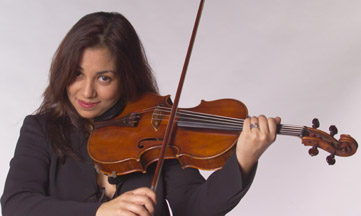
Me (Rita Porfiris - Viola)